

If you are searching for CDL Class A training in Levittown, PA, you are probably comparing more than school names. You need to know how the licensing process works, what you will practice, how long training may take, and whether the program will prepare you for both the Pennsylvania skills test and an entry-level driving job.
This guide explains the process from commercial learner’s permit to test readiness. It also shows how Patriot CDL’s four-week, 160-hour Class A program organizes theory, pre-trip inspection, range skills, and road training. Regulatory details were reviewed against current PennDOT and FMCSA information on July 24, 2026; always confirm your individual eligibility and documents before acting.
CDL Class A Training in Levittown: The Quick Answer
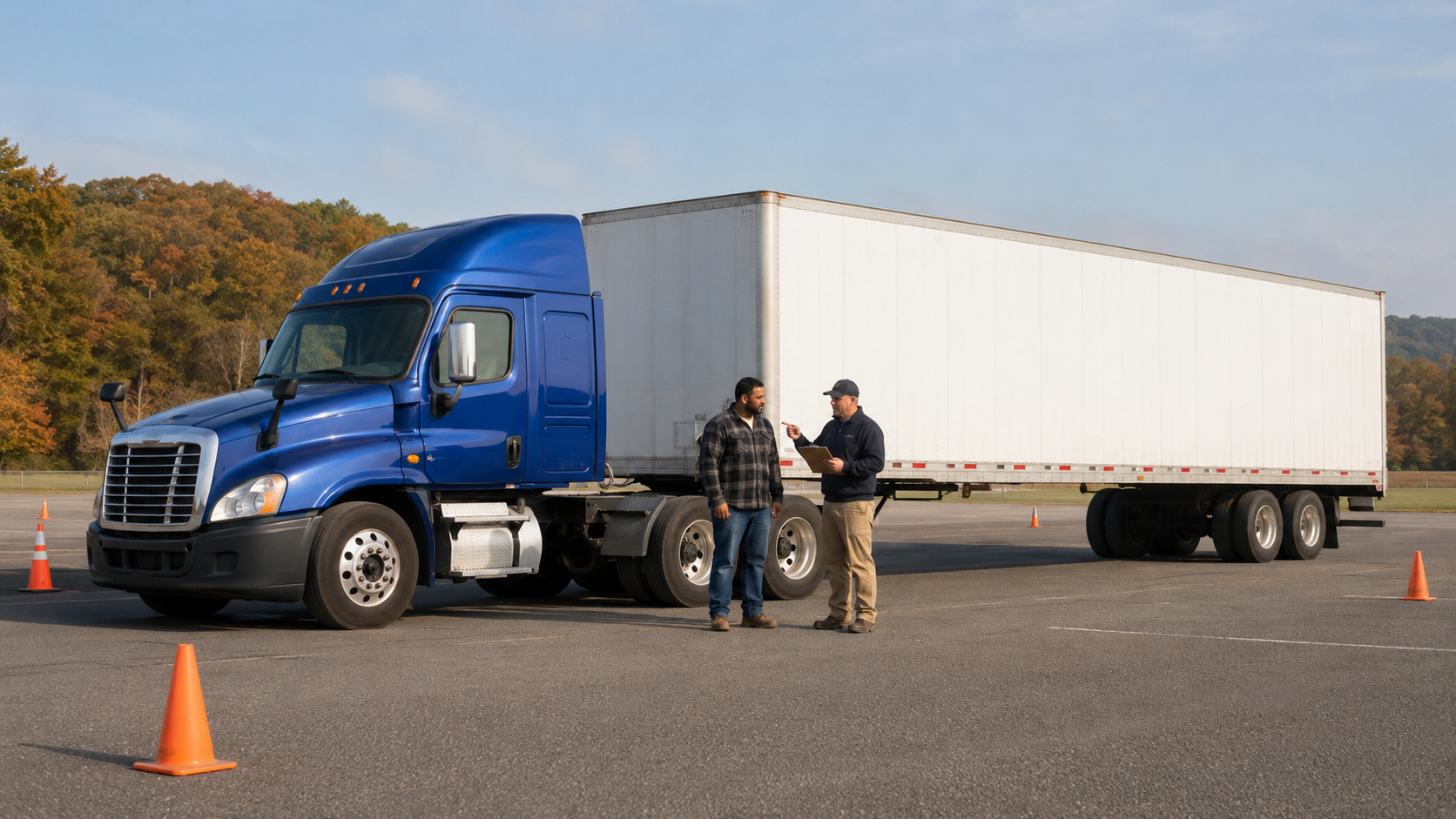
A Class A CDL generally prepares you to operate combination vehicles such as tractor-trailers when the combination meets federal and state weight definitions. For a first-time Pennsylvania Class A applicant, the normal path includes applying for the appropriate commercial learner’s permit, passing required knowledge tests, completing applicable Entry-Level Driver Training (ELDT) with a registered provider, practicing with qualified supervision, and passing the full CDL skills test.
Patriot CDL’s Levittown program is designed as a focused four-week progression: 40 hours of ELDT theory followed by 120 hours of practical range and road training. Explore the complete Patriot CDL Class A program before comparing schedules and enrollment options.
| Program element | Primary purpose | What readiness looks like |
|---|---|---|
| ELDT theory | Build the regulatory, safety, and vehicle-systems foundation | You can explain procedures and make safe decisions |
| Pre-trip inspection | Identify safety-critical components and defects | You follow a complete, repeatable inspection route |
| Range training | Develop low-speed control and backing accuracy | Your setups, mirror use, and corrections are consistent |
| Road training | Apply safe-driving habits in real traffic | You manage space, speed, turns, signs, and observation |
| Mock testing | Connect each skill under test-day conditions | You can recover calmly and complete full simulations |
The Pennsylvania Class A Licensing Path
Step 1: Prepare the application and medical information
Pennsylvania CDL applicants must identify their commercial driving type through self-certification. Depending on that category, a valid Medical Examiner’s Certificate may need to be on record. PennDOT’s current commercial-driver resources explain the application, medical-certification, testing, and documentation pathways. Review the official PennDOT Commercial Drivers page rather than relying on an old checklist.
Step 2: Pass the required knowledge tests
PennDOT issues a Knowledge Test Authorization for the requested CDL class, endorsements, or restriction removals. The authorization itself is not a permit to practice in a commercial vehicle. After you pass the required knowledge testing, PennDOT issues the actual CLP that allows supervised practice.
PennDOT’s current CDL FAQ states that every Class A applicant must pass the general knowledge test. Additional knowledge tests depend on the vehicle, brake system, and endorsements involved. Study from the current Pennsylvania Commercial Driver’s Manual and make sure your requested privileges match your career goal.
Step 3: Complete required ELDT
FMCSA’s ELDT rules apply to most first-time Class A and Class B applicants, Class B drivers upgrading to Class A, and first-time applicants for certain endorsements. The required training must come from a provider listed in the federal Training Provider Registry. The state must be able to verify the applicable training record before allowing the relevant skills or knowledge test. You can review the official FMCSA ELDT applicability guidance.
Step 4: Observe Pennsylvania’s permit waiting period
PennDOT’s CDL learner’s-permit procedures require a minimum waiting period of 15 days from the date the permit is issued until the scheduled Class A, B, or C skills test. You may schedule earlier, but the test date must satisfy the waiting period. Use this window for structured practice—not passive waiting.
Step 5: Pass the complete CDL skills test
PennDOT’s modernized CDL test includes three parts: vehicle inspection, basic control skills, and an on-road test. You must demonstrate all three skill groups in an appropriate vehicle. The vehicle you test in can affect restrictions on the CDL, including transmission or air-brake restrictions.
| Licensing milestone | Who verifies it | Common avoidable problem |
|---|---|---|
| Application and self-certification | PennDOT | Submitting the wrong driving category or incomplete documents |
| Knowledge tests and CLP | PennDOT | Confusing the Knowledge Test Authorization with a driving permit |
| ELDT completion | Registered provider and FMCSA registry | Training with a provider that cannot submit the required record |
| 15-day waiting period | PennDOT/testing provider | Scheduling the test before the permit becomes eligible |
| Full skills test | PennDOT or authorized tester | Arriving in a vehicle that creates unwanted restrictions |
What a Four-Week Class A Training Plan Can Look Like
A calendar alone does not make a student ready. A useful accelerated program creates a sequence in which every week supports the next. Students first understand the vehicle and safety rules, then develop control on the range, then transfer those habits to public roads and full test simulations.
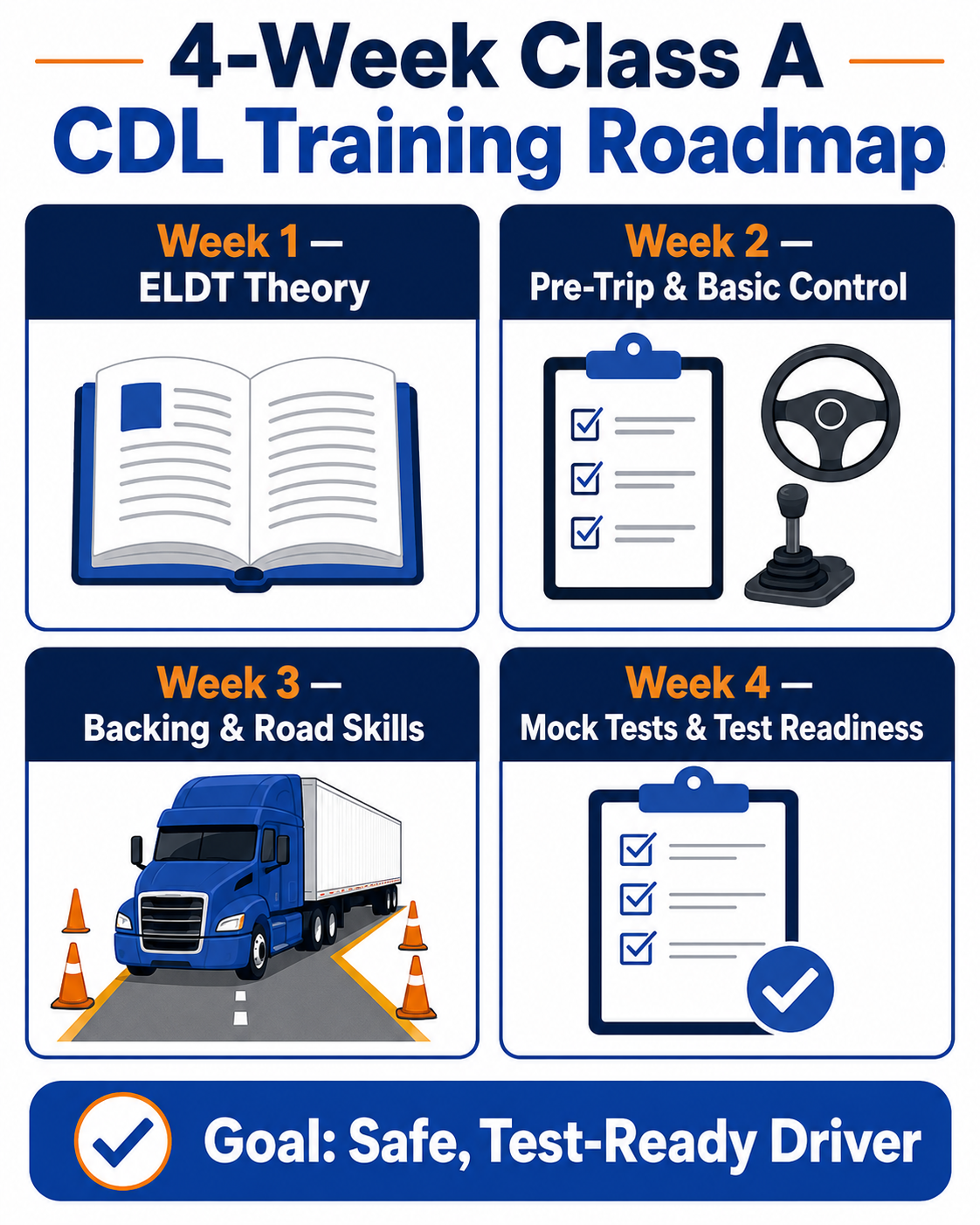
Week 1: ELDT theory and vehicle knowledge
The first phase covers the knowledge needed to train safely: vehicle systems, inspection principles, safe operating practices, hours-of-service awareness, hazard perception, railroad crossings, extreme conditions, cargo considerations, driver wellness, and federal responsibilities. Theory should help you understand why a procedure matters—not merely supply vocabulary for a quiz.
Week 2: Pre-trip and basic control
Students begin turning knowledge into a physical routine. That includes identifying components on the actual vehicle, explaining what makes them safe, learning cab controls, and building basic clutch, steering, braking, and mirror habits. Straight-line backing is the foundation for more complex maneuvers.
Week 3: Backing maneuvers and road skills
As vehicle control becomes more consistent, training expands to offset backing, alley dock, and parallel-style exercises as applicable. Road sessions add turns, intersections, lane position, speed and space management, visual search, communication, railroad crossings, and safe response to changing traffic.
Week 4: Full simulations and targeted correction
The final phase should combine pre-trip, range, and road skills under realistic pressure. Instructors identify the student’s weak areas, repeat them deliberately, and use mock evaluations to measure consistency. A student is ready when safe performance is repeatable—not when the calendar reaches a particular day.
The Skills Your Class A Program Should Build
Good CDL training does more than teach a route through the exam. It develops habits that transfer to a first job. The most valuable programs connect technical knowledge, physical control, and decision-making.
- Systematic vehicle inspection: Follow the same logical route and explain component condition clearly.
- Mirror discipline: Scan both sides frequently and connect mirror information to small corrections.
- Backing setup: Begin each maneuver from a controlled position instead of trying to rescue a poor setup.
- Space management: Protect the tractor, trailer, and surrounding traffic during turns and lane changes.
- Speed selection: Enter curves, grades, intersections, and changing conditions at a manageable speed.
- Professional communication: Signal early, make observation visible, and communicate concerns before they become hazards.
- Calm correction: Stop, reassess, and make a deliberate correction rather than compounding an error.
Because vehicle inspection is often the most language-intensive portion of the exam, use Patriot CDL’s pre-trip inspection training resource to understand how a repeatable routine supports both test performance and real-world safety.
How to Evaluate a CDL School Near Levittown
Before enrolling, compare what is actually delivered—not just the advertised program length. Ask specific questions and request clear answers.
| Question to ask | Why it matters | Strong answer should include |
|---|---|---|
| Is the provider listed for the ELDT I need? | Your completion must be verifiable | Correct Class A theory and behind-the-wheel scope |
| How much behind-the-wheel practice is included? | Observation is not the same as driving | A clear schedule and realistic student access |
| Which transmission and brake system will I test in? | The vehicle can affect restrictions | An explanation tied to your career goals |
| How are weak skills identified? | Students progress at different rates | Mock evaluations and targeted correction |
| What costs are separate from tuition? | Budget surprises can delay testing | A written list of school and third-party fees |
| What schedules are available? | Consistency affects progress | Start dates, daily hours, attendance expectations, and make-up policy |
| How does job support work? | A CDL is the start of the career | Resume guidance, recruiter access, or employer introductions without unrealistic guarantees |
Planning the Career After CDL School
Your first driving job should match your license, endorsements, age, driving record, home-time needs, and willingness to travel. A Class A CDL can support several paths, but not every employer hires graduates under the same conditions.
Local driving
Local work may offer frequent home time, but entry-level availability varies. Jobs can involve food service, building materials, intermodal freight, beverage delivery, or other physical and schedule demands.
Regional driving
Regional routes cover a defined area and may provide a balance between mileage and home time. New drivers should ask how often they return home, whether weekend work is required, and how training pay differs from solo-driver pay.
Over-the-road driving
OTR roles can provide broad experience and substantial mileage, but they require comfort with longer periods away from home. Ask recruiters about dispatch expectations, equipment, route patterns, training length, and the exact compensation structure.
Do not choose a first job from one headline number. Compare guaranteed pay, mileage assumptions, unpaid time, benefits, training obligations, equipment, safety culture, home time, and any repayment agreement. A school should help you ask better questions, not pressure you into one carrier.
Frequently Asked Questions
How long does Class A CDL training take at Patriot CDL?
The standard Patriot CDL Class A program is structured across four weeks and 160 total hours: 40 hours of ELDT theory plus 120 hours of practical range and road training. Individual licensing timelines can also depend on permit eligibility, attendance, progress, and test scheduling.
How long must I wait after receiving a Pennsylvania CLP?
PennDOT requires a minimum 15-day waiting period from the permit issue date until the scheduled Class A, B, or C skills test. You can use that time for supervised, structured practice.
Does every first-time Class A applicant need ELDT?
Most first-time Class A applicants are subject to the federal ELDT requirements. Exceptions exist, so verify your individual situation with FMCSA and PennDOT. When ELDT applies, complete it with a provider listed in the Training Provider Registry.
Where is Patriot CDL located?
Patriot CDL is located at 7800 Bristol Pike, Levittown, PA 19057. Review the school’s CDL training options and contact information before visiting.
Educational content only. Requirements, forms, fees, and testing procedures can change. Confirm current information with PennDOT, FMCSA, and your testing provider. Official information reviewed July 24, 2026.