

Finding the right training program is the first real move you'll make in your trucking career, and I bet your search for "cdl courses near me" started online. The good news is, with drivers in such high demand, you’ve got options. Your job, though, is to find a quality program—not just the one that’s closest to home.
How to Start Your Search for Local CDL Courses

Jumping into the world of trucking is a big decision, and it’s a great time to do it. The demand for new drivers is through the roof, largely because of a nationwide shortage that some reports put as high as 78,000 drivers. This gap is growing as older drivers retire and e-commerce keeps booming.
What does that mean for you? It means trucking companies are hungry for well-trained graduates from reputable schools. So, your first real task is to build a solid list of potential schools in your area that are actually worth a closer look.
Go Beyond a Simple Online Search
Sure, a quick Google search is the obvious first step, but the best programs aren't always sitting at the top of the results. You need to dig a little deeper to get the full picture of what’s available around you.
Here are a few proven ways to find the real gems:
- State DMV/RMV Websites: This is your official source. Your state's Department of Motor Vehicles almost always keeps a list of state-licensed and approved training providers. This is your baseline for legitimacy.
- Trucking Company Recruitment Programs: Big carriers are always looking for new talent and often partner with specific CDL schools they trust. Head over to the "Careers" pages of a few major trucking company websites. You might find they sponsor or recommend schools right in your backyard.
- Local and Vocational Directories: Don't forget to check out local community colleges or vocational schools. Many offer excellent CDL programs that can be more affordable and are often highly respected by local employers.
As you start jotting down names, consider how far you’re willing to travel each day. A school just 10 minutes away is convenient, but what if another one an hour away offers twice the hands-on driving time? For example, people looking for truck driving schools in California will find a huge variety in program focus and quality across the state.
Pro Tip: Your absolute first check on any school should be its accreditation. A legitimate program must be licensed by the state. Many are also accredited by agencies recognized by the U.S. Department of Education, which is a solid indicator they meet high-quality standards.
Organize Your Findings
As you find potential schools, you need a way to keep everything straight. A simple list or spreadsheet is perfect for this. Right now, you're not making a final choice; you're just building your pool of candidates.
Here’s a simple table you can use to organize your initial search. Just copy it down or create your own spreadsheet to keep your notes clean and easy to compare.
| Your Initial CDL School Search Checklist |
| :— | :— | :— | :— | :— |
| School Name | Location / Distance | Accreditation Status | CDL Class Offered (A, B, C) | Initial Contact Made (Y/N) |
Having this information in one place will be a huge help when you start making calls and digging into the details of each program. It turns a messy pile of browser tabs and notes into an actionable plan.
What Makes a CDL Program Genuinely Good?
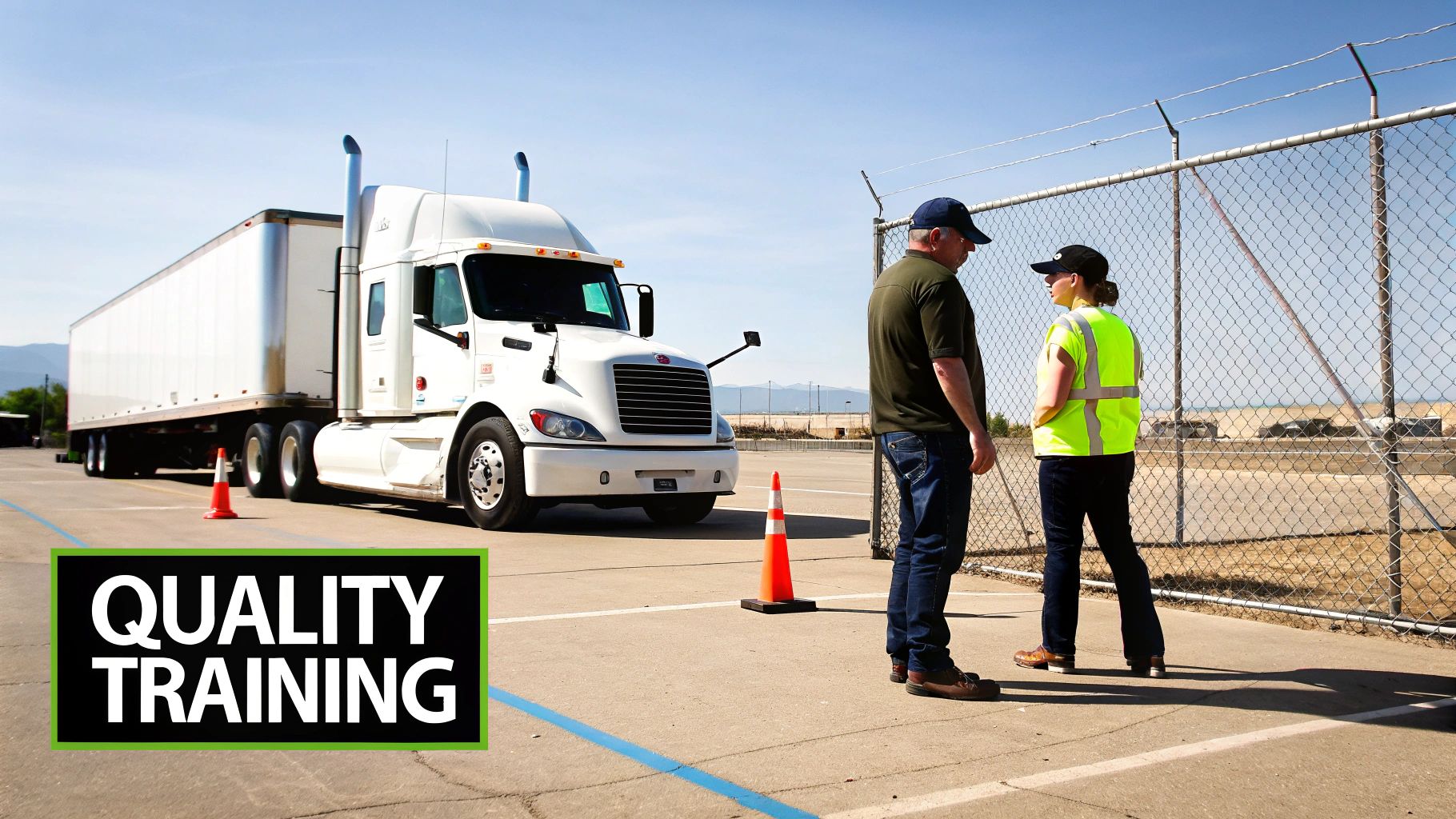
Okay, so you’ve got a list of schools in your area. Searching for "CDL courses near me" is the easy part. The real challenge is sifting through them to find one that will actually make you a competent, hirable driver.
Let’s be clear: not all training is the same. The quality of the program you choose directly impacts how confident and safe you'll be when you're finally on your own.
So, what's the most important thing to look for? It’s simple: behind-the-wheel (BTW) time. Classroom sessions are fine for getting you through the written permit test, but nothing—absolutely nothing—can replace time spent with your hands on the wheel of a real truck. A top-tier school knows this and builds its entire program around practical, on-the-road experience.
You'll see a lot of programs advertising fancy simulators and online classes. While those can be helpful tools, they are no substitute for actually feeling the gears, navigating traffic, and backing into a tight spot.
The Questions You Need to Ask Admissions
When you start calling schools, you're not just a potential student; you're a customer making a serious investment. Don't be timid. A reputable school will be transparent and ready to give you straight answers.
Here’s what you need to drill down on:
- How much actual driving time do I get? Get specific here. Ask for the total number of hours you will be personally operating the truck. Time spent in the back seat observing another student doesn't count as your training.
- What’s the student-to-instructor ratio in the truck? One-on-one is the gold standard. A 2:1 ratio can work, but if they tell you it’s 4:1, you should run. That means you’ll spend most of your expensive training time just sitting and waiting.
- Are the instructors retired professional drivers? You want to learn from someone who has lived the life. The best instructors have decades of real-world road time, and their practical wisdom is something you'll never find in a textbook.
- What kind of equipment will I train on? Learning on modern equipment is key. Ask about the age of their fleet and whether they train on manual or automatic transmissions. You want to be prepared for the trucks you'll actually be driving on the job.
A great CDL program does more than just teach you to pass the test. It builds you into a confident, safe driver who is ready for the realities of the job, from mastering pre-trip inspections to handling a rig on crowded city streets.
Checking for a Solid, Compliant Curriculum
The trucking industry is regulated for good reason—public safety. Any school worth its salt must be fully compliant with the rules set by the Federal Motor Carrier Safety Administration (FMCSA).
First and foremost, make sure the curriculum meets all Entry-Level Driver Training (ELDT) requirements. This is a federal standard that outlines the minimum knowledge and skills new drivers must have. Ask if the school is listed on the official Training Provider Registry to be sure.
Beyond the basics, dig into what the program actually teaches. A comprehensive curriculum should cover everything from fundamental maneuvers and backing techniques to advanced defensive driving. Before you sign anything, take the time to review the complete CDL training program details. This gives you the full picture of the skills you'll walk away with.
Comparing the True Cost of CDL School

When you start searching for CDL courses in your area, the first number that jumps out is usually the tuition. It’s tempting to think that’s the final price, but I’ve seen too many new drivers get blindsided by extra costs. The sticker price is rarely the whole story.
Figuring out the real financial picture is a crucial step. A program that looks like a bargain on paper can quickly get expensive when they start adding fees for every little thing. On the flip side, a school with a higher price tag might offer incredible value that saves you a ton of money and stress in the long run.
Breaking Down the Full Price Tag
To really compare schools apple-to-apples, you’ve got to add up all the potential expenses. Don't let yourself get caught off guard by hidden costs after you've already committed. Your total investment in CDL training goes way beyond just the classes themselves.
Before you sign anything, ask for a complete, itemized breakdown of costs. Here's what you need to look for:
- Tuition: This should cover your classroom instruction and time behind the wheel in their trucks.
- Permit Fees: The state fee for your Commercial Learner’s Permit (CLP).
- DOT Medical Exam: Every driver needs this physical to prove they're medically fit to drive.
- Drug Screening: A standard requirement across the entire industry.
- Licensing and Testing Fees: What the state charges you for the final road test and to print your physical CDL.
Some schools bundle these into one package deal, which is great for simplicity. Others bill for them separately. Just make sure you get it all in writing so you know exactly what you’re paying for.
How to Fund Your CDL Training
Seeing the total cost can feel overwhelming, but don't let it discourage you. Most aspiring drivers I've talked to are surprised by how many financial aid options are out there. You probably have more ways to pay for your new career than you realize.
The key is to explore every avenue. Many successful drivers I know started their careers with little to no out-of-pocket expense by tapping into programs they didn't even know existed.
Let's walk through some of the most common ways to pay for your training:
- Federal Financial Aid: If a school is accredited, it might be eligible for federal aid like Pell Grants. Your first step is to fill out the Free Application for Federal Student Aid (FAFSA) to see what you qualify for.
- Veterans' Benefits: If you're a veteran, your GI Bill® benefits can often cover 100% of your CDL training costs. It's an incredible resource you've earned.
- State Workforce Programs: Check with your local unemployment or workforce development office. Many states have grant programs designed to train people for high-demand jobs like trucking.
- Carrier-Sponsored Training: This is a fantastic deal. A trucking company pays for your school in exchange for you driving with them for a set period, usually about a year. It's one of the fastest ways to start your career with zero upfront cost.
Remember, don't just look at the price tag—look at the value. A pricier school that provides extensive behind-the-wheel time, modern trucks, and real job placement support is a much better investment than a cheap program that just teaches you the bare minimum to pass a test. Your goal here isn't just to get a license; it's to become a skilled, confident, and hirable professional driver.
Matching a School to Your Career Goals

Getting your CDL is more than just learning to drive a truck; it's the first real step in a new career. And just like any other profession, not all trucking jobs are created equal. The right school will do more than just teach you to pass the test—it'll prepare you for the specific job you want.
This is where your long-term vision comes in. Think of your CDL training as the foundation for crafting a solid career development plan. Are you aiming for long-haul routes, local delivery, or something specialized like tanker or hazmat?
Your daily life and responsibilities shouldn't hold you back, either. Most people start their search with "CDL courses near me," hoping to find something that won't upend their entire life. The key is to find a program that works with your schedule, not against it.
Finding a Schedule That Works for You
Sure, a full-time, accelerated program gets you in the driver's seat the fastest. But for many of us, that's just not realistic. Good schools get this, and they offer different formats to fit the lives of working adults.
Keep an eye out for schools that provide options like:
- Part-Time Programs: These courses spread the training out over several weeks or months, making the workload much more manageable if you're juggling a job or family.
- Weekend Courses: Perfect if you have a typical Monday-to-Friday gig. Training is concentrated on Saturdays and Sundays, so you don't have to sacrifice your weekday income.
- Evening Classes: Some schools run classes after 5 PM. While this is a great option, be honest with yourself about learning to handle an 80,00-pound rig at night when visibility is low.
A school offering flexible schedules is a great sign. It shows they understand their students are real people with real lives. That said, I always recommend prioritizing programs that give you plenty of safe, daytime driving hours. That’s when you’ll build the core confidence you need behind the wheel.
Choosing Endorsements to Boost Your Career
Think of endorsements as your CDL's superpowers. A standard Class A license is your entry ticket, but endorsements are what unlock the higher-paying, more specialized jobs. Before you sign on the dotted line, make sure the school you’re looking at actually offers the training you need for the endorsements that match your goals.
What kind of driver do you want to be?
- Hazmat (H): This one lets you haul hazardous materials and often comes with a nice pay bump. You'll need to pass a background check and a separate test, but it's a valuable credential to have.
- Tanker (N): If you want to transport liquids—anything from milk to fuel—you'll need the Tanker endorsement. It takes special skill to handle the "slosh" of liquid cargo, and good training is non-negotiable.
- Doubles/Triples (T): This endorsement allows you to pull two or three trailers at once. It's a must-have for many LTL (less-than-truckload) carriers and can seriously increase your earning potential.
It’s a good idea to review the specific CDL requirements to see how everything fits together. Picking a school that can train you for the right endorsements from day one is a smart, strategic move that will pay dividends the moment you hit the road.
Making Your Final Decision Before You Enroll
You’ve done the hard work of digging through websites and making calls. Now it's time for the final, most important reality check before you put your time and money on the line. This is where you move from online research to on-the-ground validation, making absolutely sure the school that looks good on paper is the real deal in person.
Get Your Boots on the Ground
Nothing—and I mean nothing—beats a physical visit. Schedule a tour with your top one or two choices and go in with a healthy dose of skepticism. This is your chance to kick the tires, literally. You'll see the actual condition of the trucks you'll be learning in, walk the driving range, and get a gut feeling for the whole operation.
A school's facilities say a lot about its standards. Pay attention to the details, because the small stuff often points to bigger issues. A program that takes pride in its work will be eager to show you around.
Your On-Site Inspection Checklist
Here’s what you need to zero in on during your tour:
- The Fleet: Take a hard look at the trucks. Are they reasonably modern and well-maintained? Or are they rust buckets that look like they barely survived the 90s? The gear you train on should be similar to what you’ll actually drive on the job.
- The Yard: Is the practice area paved, spacious, and set up for multiple trucks to practice maneuvers safely? Or is it a cramped, muddy field? A professional setup is a must-have, not a nice-to-have.
- The Instructors: Try to chat with an instructor for a minute. Do they seem engaged, experienced, and genuinely invested in teaching? Or do they look like they’re just punching a clock? Great instructors are the backbone of any great CDL program.
Talk to the Real Experts: Current Students
An admissions rep will give you the polished sales pitch. Current students? They'll give you the unvarnished truth.
If you see students hanging around on a break, politely ask for a minute of their time. Their honest, off-the-cuff feedback is gold.
I always tell prospective drivers: a five-minute conversation with a student in the parking lot can tell you more than an hour-long meeting with an admissions counselor. Ask them if they feel they’re getting enough driving time and if the instructors are supportive.
Review Your Top Choices Side-by-Side
To make this final step easier, lay out all the facts in one place. A simple comparison chart can instantly clarify which school truly aligns with your needs.
Your CDL School Feature Comparison
| Feature | School A | School B | School C |
|---|---|---|---|
| Total Cost | |||
| Schedule Flexibility | |||
| Student-to-Instructor Ratio | |||
| Hours of Behind-the-Wheel Time | |||
| Job Placement Assistance Rate | |||
| Equipment Condition (Your Rating) |
Seeing everything laid out like this removes the guesswork. It forces an objective look at the data you've collected, helping you make a decision based on facts, not just feelings.
Scrutinize the Enrollment Contract
The final piece of this puzzle is the paperwork. Before you sign a single thing, read the enrollment agreement from top to bottom. This isn't just a formality; it's a legally binding contract. You need to understand every word.
Pay extremely close attention to the fine print, especially sections on refund policies and the total, all-in cost. Are all the fees you talked about clearly itemized? What happens if you have to withdraw for an emergency? A transparent school will have fair, easy-to-understand policies in writing.
Taking these final steps ensures you’re making a confident investment in your future. Once you are absolutely sure, you can move forward with signing up and get your journey started. And don't forget to look ahead at other industry hurdles, like understanding the pre-employment medical examination requirements, which are a standard part of the hiring process.
Got Questions About CDL Courses? We've Got Answers
Searching for "CDL courses near me" is bound to bring up a ton of questions. That’s completely normal—this is a big career move, and you need good information to make the right call. Let's tackle some of the most common things people ask when they're starting out.
How Long Does It Really Take to Get a CDL?
This is probably the number one question on everyone's mind, and the answer really depends on the program you choose. Most full-time Class A programs are built for speed. You can find excellent, accelerated courses that get you licensed and ready to work in just three to four weeks. It's intense, but it's perfect if your goal is to start earning a paycheck as fast as possible.
Of course, not everyone can drop everything for a month. That’s where part-time or weekend programs come in. They offer more flexibility, but you can expect the training to stretch out over several months. This is a fantastic option if you need to keep your current job while you work toward your CDL.
The Bottom Line: You can get licensed in under a month with a focused, full-time program. But the best timeline is the one that fits your life without burning you out.
Will I Have a Job Lined Up When I Graduate?
Absolutely. The demand for qualified drivers is through the roof, and for good reason. Trucking companies are always on the lookout for fresh talent and often work directly with reputable CDL schools to find their next hires.
The best schools offer robust job placement assistance. They’ll help you with resumes, applications, and interview prep. It’s not unusual for them to bring company recruiters right to the school to meet with students. In many cases, students have a conditional job offer in hand before they even take their final skills test. This is one of the biggest perks of picking a school with solid industry connections.
What's on the Written CDL Exam?
Before you can even think about getting behind the wheel, you have to pass the written exam to get your Commercial Learner's Permit (CLP). It’s a multiple-choice test that covers the core knowledge every single commercial driver needs to be safe and legal on the road.
You'll need to know your stuff on several key topics:
- Basic Vehicle Control: Getting a feel for the sheer size and weight of a commercial truck.
- Safe Driving Practices: This covers everything from managing your speed and space to spotting hazards before they become problems.
- Vehicle Inspections: The all-important pre-trip, en-route, and post-trip inspection process. You have to know this inside and out.
- Transporting Cargo Safely: The rules and regulations for securing and handling whatever you're hauling.
Don't underestimate this test. Studying hard is the key to passing on your first try. If you want a closer look at what the exam involves, our guide to the CDL general knowledge test breaks it all down. This book knowledge is the foundation for everything you'll do on the road.
Ready to stop searching and start driving? At Patriot CDL, we provide accelerated, hands-on training that gets you on the road to a new career in weeks, not months. https://patriotcdl.com