

Before you can even think about hitting the road in a big rig, you have to conquer the CDL general knowledge test. This isn't just another box to check; it's the first and most critical step for any aspiring professional driver. Think of it as the foundation for your entire career—it’s what proves you have the core knowledge to operate a massive vehicle safely from day one.
Why Mastering CDL General Knowledge Matters
You can look at this test in two ways: as something to just pass, or as the operating manual for your future on the road. I've seen plenty of drivers do the first, but the ones who have long, successful careers are the ones who truly master these concepts.
This isn't about rote memorization. It’s about deeply understanding the principles that will protect you, your truck, your cargo, and every other person on the highway. Passing this exam is the official stamp that says you're ready for the immense responsibility that comes with getting behind the wheel.
The whole point of this rigorous testing is to make sure drivers have real, practical skills. It’s a classic example of competency-based training, where the focus is on what you can actually do, not just what you know. If you want to dive deeper into the nuts and bolts, you can get a full breakdown of the test here: https://patriotcdl.com/general-knowledge-test/
The Pillars of Professional Driving
When you start studying, you'll see a few core themes pop up again and again. These aren't just topics for the test; they are the absolute non-negotiables you'll live by every single day as a professional driver.
- Vehicle Mastery: You have to know your truck inside and out. This means mastering the pre-trip inspection and learning to recognize the subtle sounds or vibrations that signal a mechanical problem before it becomes a disaster on the interstate.
- Defensive Driving: This is so much more than the rules of the road you learned for your car. We're talking about actively managing the huge space cushion your rig needs, constantly scanning for hazards, and knowing exactly how speed and bad weather impact your stopping distance.
- Cargo Safety: A huge part of your job is what's in the trailer. You’re responsible for it. That means knowing how to distribute weight correctly, secure your load so it doesn't shift, and stay within legal limits to prevent accidents and avoid expensive fines.
Getting these fundamentals down sets you up for a great career in an industry that's the backbone of our economy. As of 2023, the U.S. trucking industry employed around 3.5 million drivers. That number shows just how essential this work is—and the opportunity it holds for stable, long-term employment if you start with the right foundation.
Mastering Your Pre-Trip Vehicle Inspection
Before you even think about putting the truck in gear, you have a critical job to do. Think of yourself as the first and most important line of defense for safety on the road. The pre-trip vehicle inspection isn’t just a checklist you run through to pass the CDL general knowledge test; it's a hands-on, non-negotiable routine that prevents breakdowns and, more importantly, saves lives.
Catching a frayed belt or a low fluid level can be the difference between a smooth run and being stranded on the side of the highway, wasting time and money. Worse, missing a cracked brake drum or a damaged tire could lead to a catastrophic failure. This process is your responsibility, and mastering it is what separates the professionals from the amateurs.
The Logic of the Inspection Walkaround
A proper pre-trip isn't a random stroll around the rig. It’s a systematic process. You follow a consistent, logical path to make sure absolutely nothing gets overlooked. Most drivers start under the hood and then work their way around the entire vehicle, usually in a counter-clockwise direction.
This methodical approach breaks a massive job down into small, manageable checks. You're building a complete mental picture of your vehicle's condition, one step at a time.
Starting Under the Hood: The Engine Compartment
Your inspection kicks off at the heart of the truck: the engine compartment. You’re not just glancing for big, obvious problems. You're getting up close to check the lifeblood of your machine.
- Fluid Levels: Check your engine oil, coolant, power steering fluid, and even the windshield washer fluid. If a level is low, it’s often the first warning sign of a leak or a bigger problem brewing.
- Belts and Hoses: Get your hands on the belts (alternator, water pump, etc.). Are they cracked, frayed, or too loose? A snapped belt can shut down essential systems in an instant. Hoses should feel firm, not soft or bulging.
- General Condition: Scan the area for loose wires, cracked parts, or any signs of fresh fluid leaks on the engine block itself.
A loose alternator belt might not seem like a big deal, but it can stop your battery from charging. That means you could end up with a dead truck hundreds ofmiles from anywhere. That's why you check for about 1/2 to 3/4 inch of play—no more, no less.
The Driver Side and Coupling System
After clearing the engine, you’ll move to the driver's side of the cab and then inspect the coupling system if you’re pulling a trailer. This zone is packed with critical safety gear. Checking fluids and tires is standard, but you're also maintaining functional side mirrors to ensure you have a clear view, which is vital for navigating tight spots or changing lanes safely.
You'll inspect your fuel tanks for any leaks and make sure the caps are on tight. From there, it’s on to the fifth wheel—the all-important link between your tractor and trailer.
- Secure Mounting: Make sure the fifth wheel assembly is bolted firmly to the frame with no missing or damaged parts.
- Locking Jaws: Get a flashlight and verify that the locking jaws have fully wrapped around the kingpin. A failed connection here is every driver's worst nightmare.
- Air and Electrical Lines: Check that your air and electrical lines are firmly connected, properly suspended, and not rubbing against anything that could wear them down.
If you want an exhaustive breakdown of this process, our detailed guide on the CDL pre-trip inspection walks you through every single checkpoint.
Tires, Brakes, and Suspension
As you continue around the truck, you shift your focus to the parts that carry the weight and bring it all to a stop. This trio—tires, brakes, and suspension—is a huge part of the CDL test for a good reason.
Your tires are your only connection to the pavement. You need to check every single one for proper inflation with a tire gauge, not just by thumping it. Look for even tread wear and inspect the sidewalls for cuts, bulges, or any other damage. A blowout on a fully loaded rig can easily cause a total loss of control.
Next, get a good look at the brake system. You’re looking for cracked brake drums or rotors and making sure the brake linings have plenty of material left. On air brake systems, you have to listen carefully for any audible air leaks—that hissing sound means you’re losing stopping power.
Finally, inspect the suspension. Check the springs, shocks, and airbags for cracks, leaks, or any visible damage. These parts keep your load stable and ensure the truck handles predictably, especially over rough roads or in a sharp curve.
Core Principles of Safe Commercial Driving
Getting behind the wheel of a big rig isn't like driving a bigger version of your family car—it's an entirely different skill set. The core principles of safe commercial driving are the absolute foundation for passing the CDL general knowledge test and building a long, safe career on the road. It all boils down to a defensive mindset: seeing trouble before it starts and always giving yourself an escape route.
This really comes down to mastering three critical areas: managing your space, controlling your speed, and spotting hazards. In a commercial truck, you can't just slam on the brakes or swerve out of the way. Your safety is determined by the smart decisions you make long before a situation gets dicey.
Managing Your Space Cushion
Imagine a protective bubble around your truck. This is your "space cushion," and keeping it intact is probably the single most important thing you can do to avoid an accident. A fully loaded rig can tip the scales at 80,000 pounds, so it needs a whole lot more room to stop and maneuver than a regular car.
You have to actively manage the space in front, behind, and on both sides of your vehicle. A good rule of thumb for following distance is to allow one second for every ten feet of your vehicle's length. Then, tack on an extra second if you're going over 40 mph. For a typical tractor-trailer, that means you need at least a 7-second gap when the weather is good.
That buffer is what gives you the time and space to react when the unexpected happens.
Understanding Total Stopping Distance
Your stopping distance isn't just about how hard you press the brake pedal. The concept of total stopping distance is a huge part of the CDL general knowledge exam, and it's made up of three distinct phases:
- Perception Distance: This is the distance your truck rolls from the moment you see a hazard until your brain actually registers it as a problem.
- Reaction Distance: Next up is the distance your truck travels while your brain tells your foot to move to the brake and you physically start to apply it.
- Braking Distance: Finally, this is the distance your rig covers from the moment the brakes engage until you come to a complete stop.
Think about this: at 55 mph, your perception and reaction time alone will let your truck travel the length of a football field before the brakes even start slowing you down. Things like bad weather, a heavy load, or worn brakes can make that distance even longer.
The table below breaks down how different factors play into your total stopping distance.
Key Factors Affecting Total Stopping Distance
| Factor | Description | Impact on Stopping Distance |
|---|---|---|
| Driver Condition | Fatigue, distraction, or impairment. | Increases perception and reaction time, adding significant distance. |
| Vehicle Speed | The rate at which the vehicle is traveling. | The higher the speed, the longer all three distances become. Doubling speed can quadruple braking distance. |
| Vehicle Weight | The gross weight of the truck, trailer, and cargo. | Heavier loads require much more braking force and distance to stop. |
| Road Conditions | Wet, icy, or snow-covered surfaces. | Dramatically reduces tire grip, which can double or triple the braking distance. |
| Brake Condition | The state of the brake system (e.g., proper adjustment, temperature). | Poorly maintained or overheated brakes are less effective, increasing braking distance. |
As you can see, stopping a commercial vehicle is a complex process. It's why anticipating road conditions and maintaining your equipment is so critical.
A mistake I see new drivers make all the time is underestimating how much slick roads change things. On wet pavement, your stopping distance can easily double. On packed snow, it can be three times longer, and on ice, it’s a whole different ballgame.
Navigating Turns and Blind Spots
Another thing that sets commercial driving apart is how your vehicle handles turns. The term for this is offtracking—it’s how your rear wheels follow a much tighter path than your front wheels. To avoid running over curbs, signs, or other vehicles, you have to swing wide, often starting your turn from the middle of your lane.
Just as crucial is knowing your blind spots, which we call "no-zones." These are huge areas around your truck where a car can vanish from your mirrors. The biggest no-zones are:
- Directly in front of your cab.
- Right behind your trailer.
- Along both sides of your entire rig, with the right side being particularly dangerous.
Constantly scanning your mirrors and being hyper-aware of these no-zones is non-negotiable for changing lanes or moving through traffic. For anyone just getting started, these are core concepts covered in any certified Entry-Level Driver Training (ELDT) program. You can get more details on what's required for new drivers by reviewing the official ELDT mandate guidelines.
This flow chart gives a great overview of a simplified vehicle inspection process, hitting the key points that directly affect safety.
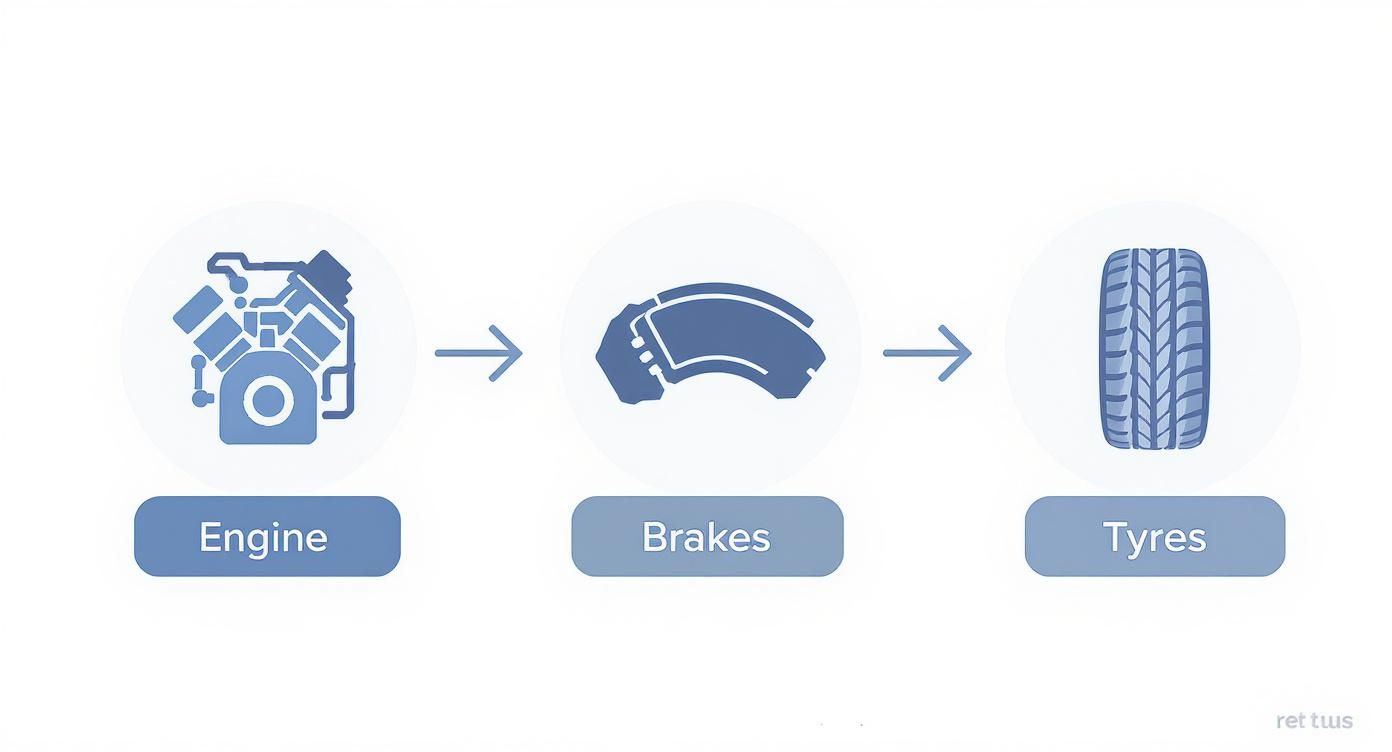
The chart really drives home the point that on-road safety begins before you even turn the key. A thorough check of your engine, brakes, and tires—the systems most critical to maintaining control—is your first line of defense.
Handling Cargo Safely and Legally
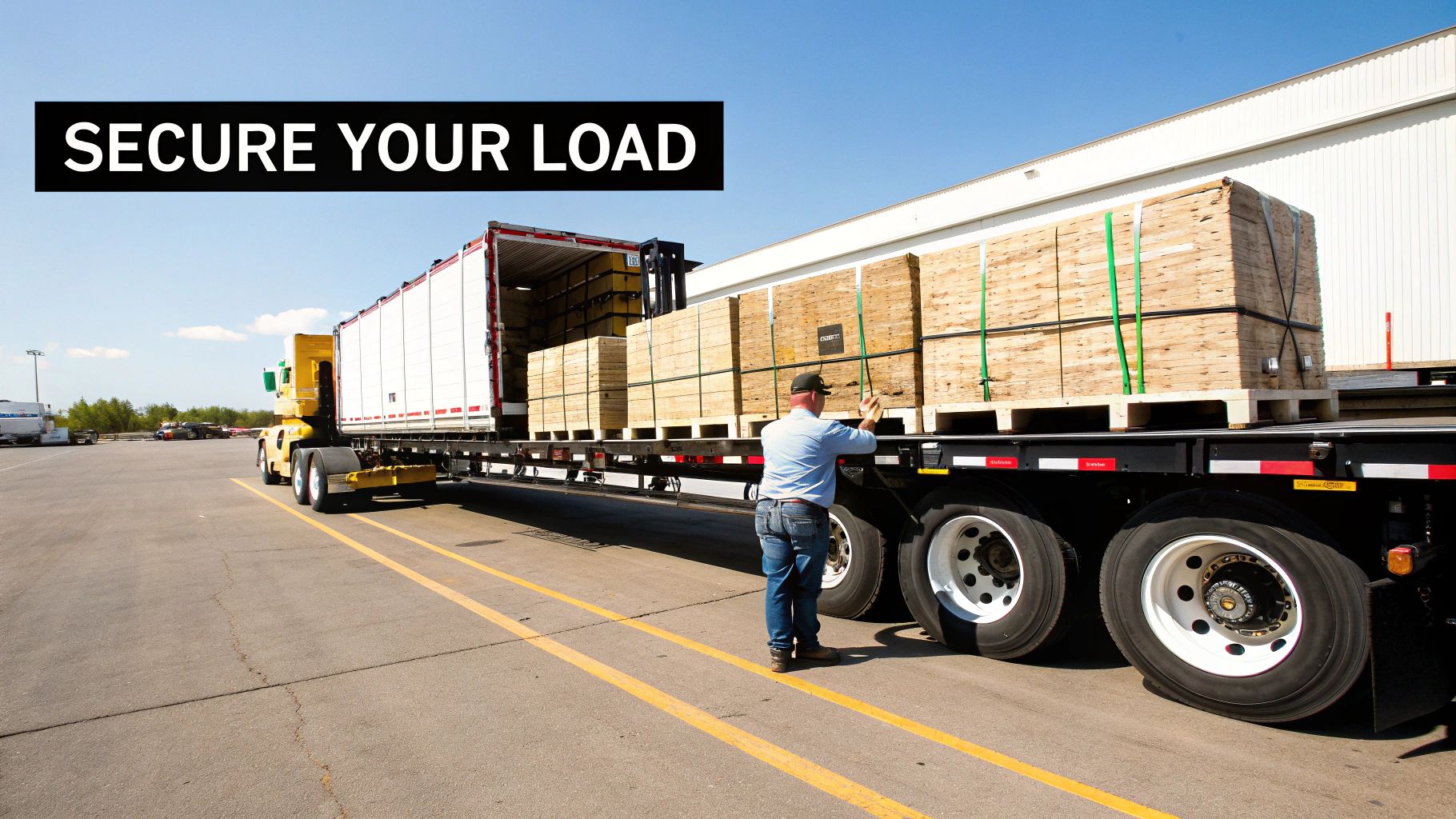
As a professional driver, your responsibility goes way beyond just what happens in the cab. Think about it: every single pound of freight in that trailer is your responsibility. That's why understanding how to manage cargo isn't just a chapter in the manual; it’s a massive part of the CDL general knowledge test. If you get this wrong on the road, it's not just a failed test—it could mean a catastrophic accident, wrecked freight, and serious legal trouble.
Getting your load properly secured and balanced is a science. It's what keeps your rig stable, prevents the kind of load shifts that can cause a rollover, and makes sure the customer's freight arrives in one piece. This is a skill you'll use every single day, and there's zero room for error.
Weight Distribution and Legal Limits
Before you even touch a strap, you have to think about weight. A badly balanced load is an absolute nightmare on the road. Put too much weight up front, and you're straining the steering axle. Put too much in the back, and you can literally lift your steer tires off the pavement, which means you have zero steering control.
The whole game is about spreading the weight out as evenly as you can, both front-to-back and side-to-side. This keeps your truck’s center of gravity low and in the middle—exactly where you need it to handle safely.
Of course, it’s not just about balance. You have to stay within strict legal weight limits. Federal law generally puts the cap at 80,000 pounds for the whole truck, but it gets more complicated. There are separate limits for single axles, tandem axles, and the "bridge formula" that governs the spacing between them. Get this wrong, and you're looking at huge fines and being put out of service until you can make the load legal.
Mastering Cargo Securement
Once the cargo is loaded and balanced, you have to lock it down so it can't go anywhere. The Federal Motor Carrier Safety Administration (FMCSA) has incredibly specific rules about this, and you can bet you'll see them on the exam. The right way to secure a load depends entirely on what you’re hauling.
- Blocking and Bracing: This is all about using lumber or other solid materials to fill in the gaps. You’re essentially wedging the cargo in place so it has no room to slide forward, backward, or sideways.
- Tie-Downs: This is your bread and butter—straps, chains, and binders. The most important thing here is knowing how many you need, which is based on the cargo's length and weight.
- Specialized Equipment: Some loads are just tricky. Think of things like big steel coils or giant concrete pipes. They require special dunnage and unique securement methods to keep them from rolling.
Here's a critical rule of thumb you need to burn into your memory: for cargo that isn't blocked at the front, you need one tie-down for the first five feet of length, plus one more for every ten feet after that. So, for a 20-foot piece of equipment, that's at least three tie-downs right there.
Calculating the Right Number of Tie-Downs
Let's walk through a real-world example. Say you're hauling a big crate that weighs 12,000 pounds and is 18 feet long. How many tie-downs do you need?
- First Five Feet: That first five feet of the crate needs one tie-down. Easy enough.
- Remaining Length: You have 13 feet left (18 ft – 5 ft). The rule says one tie-down for every additional 10 feet or any part of it. Since 13 is more than 10, that counts as two more tie-downs.
- Total: Add it up, and you need a bare minimum of three tie-downs just based on the length.
But you're not done yet. You also have to check the working load limit (WLL) of your equipment. The WLL of all your straps combined has to equal at least 50% of the cargo's weight. So for that 12,000-pound crate, your tie-downs must have a combined WLL of at least 6,000 pounds.
Special Cargo Considerations
Not all freight is created equal. Some loads demand extra training and, often, a special endorsement on your CDL. Hauling hazardous materials, for instance, means you need to know about placarding your truck, carrying the right shipping papers, and what to do in an emergency. The general knowledge test will touch on these basics, but the full Hazmat endorsement is its own separate beast. Knowing the different CDL requirements is the first step to moving up in your career.
This kind of specialized skill is more valuable than ever. The demand for truck drivers is growing, which creates both problems and opportunities. Some projections show the U.S. could be short as many as 78,000 drivers by 2025, mostly because of retirements and the simple fact that we're shipping more stuff. While that’s a headache for the supply chain, it’s a golden opportunity for anyone with a CDL, offering great pay and job security—especially if you have those specialized endorsements.
Strategic Approaches to the CDL Exam
Knowing the material is one thing, but knowing how to take the test is what gets you a passing score. The CDL general knowledge exam isn’t trying to trick you; it’s a direct assessment of what you need to know to be a safe, competent driver. A solid strategy can turn test-day nerves into confidence.
Most states give you a 50-question multiple-choice test, and the magic number to pass is 40 correct answers—that’s an 80%. While you should always check your state's specific CDL manual for the exact numbers, this format is pretty standard across the board.
Decoding the Exam Format
The good news? It's all multiple-choice. This means the right answer is always right there in front of you. Your job isn't just to find it, but to get good at spotting and tossing out the wrong answers. Shifting your mindset to this "process of elimination" approach is a game-changer.
The best way to get comfortable is to see what the questions actually look like. Taking practice tests is key. If you want a head start, you can dive into some realistic questions on our General Knowledge Test 2EN page. It’s the perfect way to get familiar with how questions are worded before the real deal.
Trucking is a massive, evolving industry. We’re talking about a global freight market worth $2.2 trillion and a U.S. workforce of about 3.54 million drivers as of 2025. The industry is also starting to shift, with the electric truck market expected to jump from $5.92 billion to $38.76 billion by 2032.
Proven Test-Taking Strategies
Once you understand the test's structure, you can use a few proven tactics to boost your score. Don't just read the questions—break them down.
- Manage Your Time: You only have so much time. If a question stumps you, flag it and move on. Knock out the easy ones first to build momentum, then loop back to the tougher ones at the end.
- The Process of Elimination: This is your best friend on a multiple-choice test. For every question, actively hunt for the options that are clearly wrong. Getting rid of even one or two bad answers seriously improves your odds.
- Spot Key Words: Look for words like "always," "never," "except," or "not." These little words are huge clues. They can completely flip the meaning of a question and often point you right to the correct answer.
Think of each question as a small puzzle. Your job is to find the piece that fits perfectly. Often, two answers will seem plausible, but only one is the most correct based on the specific wording of the question and the rules in the CDL manual.
For instance, a question might ask what you should always do when backing. You might see options like "use a spotter," "turn on your four-way flashers," or "honk your horn." Flashing your lights and honking are good habits, but the one non-negotiable rule is to use a spotter whenever possible. That makes it the best answer.
Combine solid studying with these smart test-taking habits, and you'll walk into that testing center ready to go. You won't just know the material—you'll know exactly how to prove it.
Your Final Checklist for Test Day Success
Alright, the big day is almost here. These last few days before your CDL general knowledge test are all about locking in what you know and walking in with confidence. Think of it like doing a pre-trip inspection on your own brain—you're not trying to build a new engine, you're just making sure everything is in top shape and ready to roll.
This exam is your ticket to a great career, and the hard work you’re putting in now is what gets you there. You've studied the truck's systems, you've learned the rules of the road—now it's time to prove it.
The Night Before and Morning Of
Your final prep starts the night before, and it has nothing to do with cramming. At this point, trying to force more information into your head will do more harm than good. Your brain needs to rest.
- Get a Good Night's Sleep: Seriously. Aim for 7-8 hours. A tired mind makes silly mistakes, and you need to be sharp.
- Eat a Solid Meal: Have a decent breakfast before you go. Skip the greasy stuff that will make you want to take a nap.
- Organize Your Documents: Lay out all your required ID and paperwork the night before. The last thing you need is a frantic search for your documents right before you have to leave.
This isn't just about being organized; it's about getting your mind right. A calm, focused approach is your best tool on test day.
Last-Minute Knowledge Review
While you shouldn't be cramming, a quick final review of the big-ticket items is a smart move. This isn't about learning anything new; it's about bringing the most important facts to the front of your mind.
Remember, this test isn't trying to trick you. It's designed to make sure you have the essential knowledge to be a safe, professional driver. Every single question is tied to something you'll actually face out on the road.
Think of this final review as a quick scan of your mental dashboard. Here's what to focus on:
- Pre-Trip Inspection: Can you mentally walk around the rig and name the key parts of the engine, coupling system, brakes, and tires?
- Air Brake Systems: Run through the air brake check in your head one last time. What are the proper psi cut-in and cut-out levels?
- Cargo Rules: Go over the basic tie-down rules. How many do you need for a 20-foot load? What's the rule for the aggregate working load limit?
- Safe Driving Principles: Think about total stopping distance, managing space, and spotting hazards before they become a problem.
Running through these key points one last time will ensure they're fresh and ready. You’ve done the work. Walk into that testing center with your head held high—you've got this.
Got Questions About the CDL Test? We’ve Got Answers.
Getting your CDL is a big step, and it's natural to have a lot of questions pop up along the way. I've put together some straight-to-the-point answers for the most common things aspiring drivers ask about the cdl general knowledge test. My goal here is to cut through the confusion so you can concentrate on what really counts: studying smart and acing that test on your first try.
Knowing what you're walking into is half the battle. If you understand the test format, the rules, and what to expect on test day, you'll feel a lot less pressure and be able to perform your best.
How Many Questions Are on the CDL General Knowledge Test?
The standard general knowledge test has 50 multiple-choice questions. To get a passing grade, you need to nail at least 40 of them, which works out to an 80% score.
Now, keep in mind that this can change a little bit depending on where you live. It's always a good idea to crack open your state's official CDL manual and confirm the exact numbers. You don't want to be surprised by a small difference in test length or the passing score.
What Topics Are Most Important for the General Knowledge Test?
Look, you need to know everything in that manual, but there are a few heavy hitters that show up on the test time and time again. If you want to pass, you absolutely have to have these areas locked down.
- Vehicle Inspections: You'll see plenty of questions about the pre-trip inspection. They get specific, too—asking about the engine, your coupling system, tires, lights, you name it.
- Safe Driving Practices: This is all about the fundamentals of staying safe on the road. Think space management, speed control, dealing with hazards, and how to handle bad weather.
- Cargo Transport: You've got to know the rules for securing your load. That means proper weight distribution, balancing, and using the right number and type of tie-downs.
- Air Brakes: The full air brake endorsement is its own test, but the general knowledge exam will still hit you with basic questions on how these systems work and how to check them properly.
Getting these core topics down cold is your best bet for passing.
If there's one area you can't afford to skim over, it's the pre-trip inspection. It’s heavily weighted for a simple reason: safety on the road starts before you even turn the key.
Can I Take the CDL General Knowledge Test Online?
Nope, you can't. The official CDL general knowledge test has to be taken in person at an official DMV or another state-approved testing center. There are no exceptions.
This rule exists to keep the test secure and fair for everyone. Having a proctor there in person confirms it’s really you taking the test and prevents any chance of cheating. Online practice tests are fantastic study tools—and you should definitely use them—but the real deal is a formal, supervised event.
What Happens If I Fail the General Knowledge Test?
Failing stings, but it's not the end of the road. In most states, you can take the test again. Just know there's usually a waiting period before you can give it another shot. This could be just one business day or maybe a week or more, depending on your state's rules.
Some states might also limit how many times you can retake it in a given timeframe. If you don't pass, treat it as a lesson. Figure out which sections gave you trouble, hit the books hard on those specific topics, and come back ready to conquer it.
Ready to stop asking questions and start building your future? At Patriot CDL, we provide the expert, hands-on training you need to pass your CDL test with confidence and launch a successful career. Learn more and enroll today at Patriot CDL.