

Let's be clear about one thing right up front: getting a CDL job without driving experience isn't just possible—it's how almost every single trucker in this country got their start. The industry is constantly on the hunt for fresh talent, and many of the biggest names in trucking have built entire programs designed to get you trained, licensed, and on the road.
Your On-Ramp to a Trucking Career
It's easy to feel intimidated when you see job postings for no experience CDL jobs, but here's the secret: "no experience" is just code for "we're ready to train you." Companies aren't looking for a seasoned pro. They're looking for someone with a Commercial Learner's Permit (CLP), a clean driving record, and a solid work ethic. They’ll handle the rest.
This investment in you usually takes the form of company-sponsored training. You're often a paid employee from the very first day, learning the ropes from a certified driver trainer. They teach you the company's specific safety procedures, how to manage your logs and routes, and all the real-world skills that a basic CDL school just can't cover.
Pathways into the Driver's Seat
When you're just starting, your first year on the road can look a few different ways. Most new drivers find themselves in one of these roles:
- Over-the-Road (OTR) Roles: This is the classic long-haul trucking life, where you'll be out for weeks at a time. It's the most common starting point because you get a massive amount of experience very quickly, driving through all kinds of terrain and weather across the country.
- Regional Routes: Think of this as a step down from OTR. You'll typically stick to a specific group of states, which means you get home more often, usually for the weekend.
- Local Delivery Gigs: These are a bit harder to land right out of the gate, but not impossible. Companies in construction or beverage distribution sometimes hire trainees for local routes, meaning you're home every single night.
The infographic below gives you a quick snapshot of what to expect in terms of training time and starting pay. As you can see, the demand is real and the pay is competitive right from the beginning.
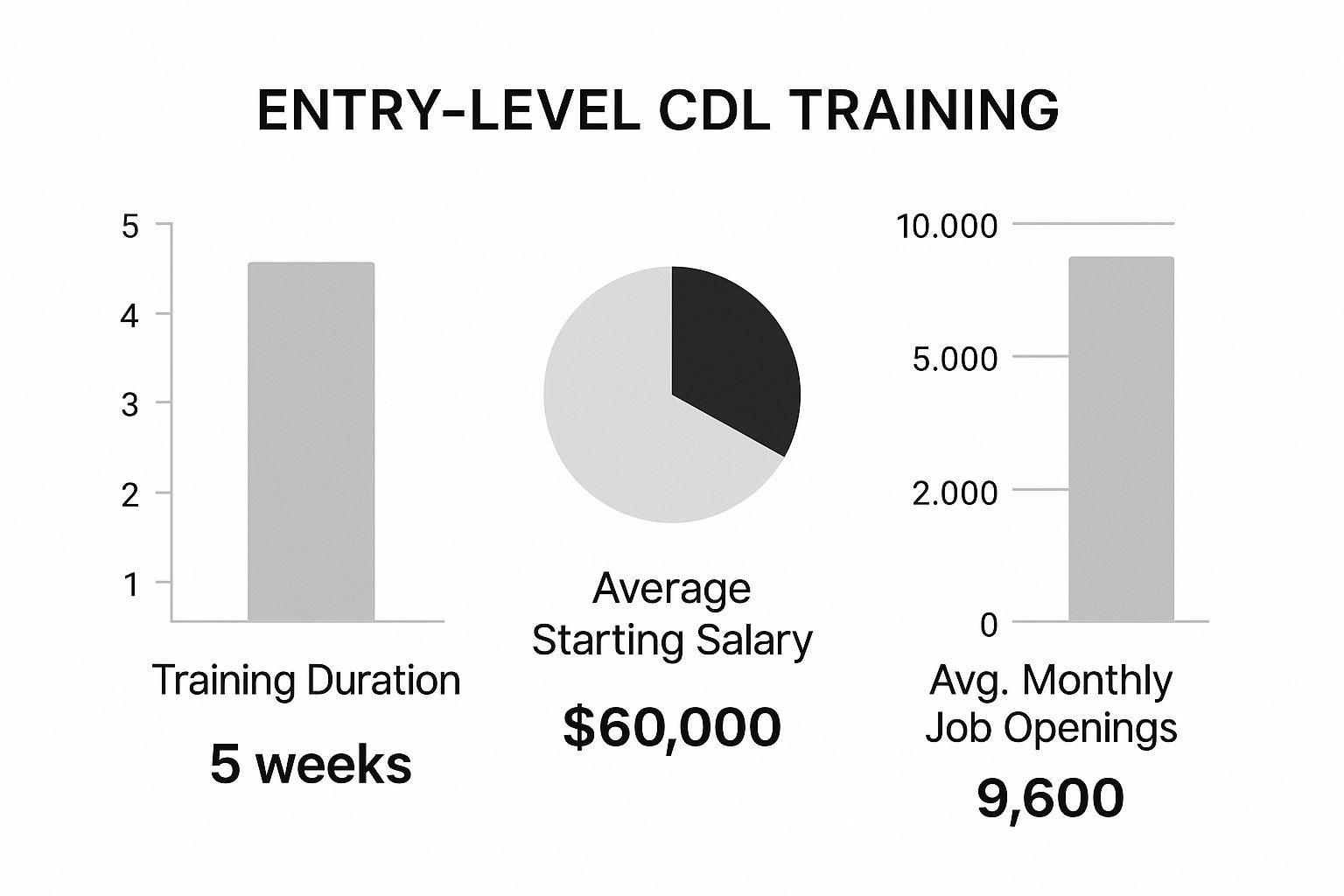
This highlights just how strong the demand is and what you can earn once you complete your initial training.
Comparing Your CDL Training Pathways
So, how do you get trained? You essentially have two main options: go through a company-sponsored program or pay your own way through a private school. Each has its pros and cons, and the right choice really depends on your financial situation and career goals.
| Feature | Company-Sponsored CDL Training | Private CDL School |
|---|---|---|
| Upfront Cost | Usually $0 or a small deposit. Training costs are covered. | $3,000 – $10,000+ out-of-pocket. |
| Job Placement | Guaranteed job with the sponsoring company upon completion. | You find your own job. School may offer placement assistance. |
| Commitment | You must sign a contract to work for the company for 1-2 years. | No commitment. You're free to work for any carrier you choose. |
| Pay During Training | Often includes a weekly stipend or hourly wage. | No pay during training. You cover your own living expenses. |
| Best For | Drivers who want a guaranteed job and have limited funds. | Drivers who want flexibility and can afford the initial investment. |
Ultimately, company-sponsored training is a fast track to a paycheck, but a private school gives you the freedom to choose your employer from day one.
What Companies Really Want
Beyond the license and the medical card, carriers are looking for two things: reliability and a deep-seated commitment to safety. A steady work history, even if it's in retail or construction, tells them you're a dependable person. Before you start filling out applications, it’s smart to get familiar with all the baseline qualifications. Getting these basics in order is your first real step.
The most important quality a new driver can possess is a safety-first mindset. Companies can teach you how to back into a tight dock, but they can't teach you to care about doing the job safely every single time. That has to come from you.
The need for new drivers isn't just talk. A quick search on any major job board will show you over 11,700 no-experience CDL job openings right now across the U.S. That's a huge number, and it proves how actively companies are trying to bring people in. Many of these positions include fully paid training that lasts around four weeks, setting you up for a stable career with good benefits like holiday pay and a 401(k).
Getting Your Permit and Choosing the Right Training
Before you can even start thinking about which no experience cdl jobs to apply for, you need to get your foot in the door. That journey starts with earning your Commercial Learner's Permit (CLP). Think of the CLP as your pass to get behind the wheel and begin hands-on training.

The process is straightforward, but it demands attention to detail. You'll have to meet the age requirements—usually 18 for driving within your state and 21 for crossing state lines—show proof of residency, and clear a Department of Transportation (DOT) medical exam. The main event, though, is passing a series of written tests on general knowledge, air brakes, and combination vehicles. Acing these is non-negotiable.
Evaluating Your Training Options
With your CLP in hand, you've reached your first major fork in the road: choosing how to get trained. This decision will have a huge impact on your first year in trucking, so it’s worth some serious thought.
There are three main paths you can take:
- Company-Sponsored Training: This is where a trucking company pays for your CDL school. The catch? You have to sign a contract to drive for them, typically for one to two years.
- Private CDL Schools: Here, you pay for your own tuition. It’s a bigger upfront investment, but it gives you the freedom to work for any carrier you want once you're licensed.
- Community Colleges: These programs tend to be more comprehensive, often spanning a full semester. While they can take longer, they might be eligible for financial aid.
Each route comes with its own set of pros and cons. Company training means an immediate job and no tuition debt, but you lose flexibility. Private schools give you freedom but hit your wallet hard. Community colleges provide a deep education but are the slowest way to get on the road.
The best training program isn't just about passing a test; it's about building a foundation that will keep you safe and successful for years. Prioritize programs with a low student-to-instructor ratio and a promise of significant behind-the-wheel hours. Those numbers are far more telling than any graduation rate.
What to Look For in a Quality Program
The lure of "free" training is powerful, but you have to look past the price tag and vet your options carefully. Not all programs are created equal. You want one that prepares you for the real world of trucking, not one that just teaches you the bare minimum to pass the skills test.
When you talk to school administrators or company recruiters, don't be shy. Ask the tough questions:
- What's your student-to-truck ratio for on-the-road training?
- How many hours will I actually spend driving on public roads, not just a practice yard?
- What's the company's safety record? And what’s your driver turnover rate?
While the industry advertises plenty of no experience cdl jobs, the reality for new drivers can be a shock. Research from the National Transportation Institute reveals that many entry-level jobs are the toughest—think long-haul, over-the-road routes with demanding schedules and very little home time.
This is a big reason why driver turnover is so high, especially in the first few months. New drivers get burned out fast. It’s a tough cycle, but it underscores why choosing the right training is so critical. A solid program that offers real support and prepares you for the job's actual demands can make all the difference in whether you stick with it and build a successful career.
A Realistic Look at Your First-Year Earnings
Let’s get right to it—what you really want to know is how much money you can make. When you're looking at no experience CDL jobs, the pay is a huge factor, and I’ve got good news. The starting salaries today are a far cry from what they used to be. Companies are fighting for good drivers, and that competition is pushing entry-level pay up.
You can realistically expect to start somewhere in the $50,000 to $65,000 range your first year. That’s not a pipe dream; it's what the data shows. Stick with it, and you could be clearing $80,000 within just a few years, especially if you move into more specialized work like hauling hazardous materials or driving a flatbed. The demand for drivers isn't going away, and that’s what keeps the pay competitive.
How You Get Paid
Your paycheck in the trucking world isn't always as straightforward as an hourly wage. It's crucial to understand the different pay structures you'll encounter so you can accurately compare job offers.
- Cents-Per-Mile (CPM): This is the bread and butter for most over-the-road (OTR) and regional drivers. You get paid a set rate for every mile you cover. For instance, if your rate is $0.55 CPM and you run 2,500 miles in a week, you've just earned $1,375 before taxes. Simple math.
- Hourly Pay: If you’re driving local routes, this is what you’ll likely see. You get paid for all your on-duty time, which includes driving, pre-trip inspections, and even waiting at a customer's dock. It’s predictable and fair, especially when you hit city traffic.
- Salaried Roles: While less common for brand-new drivers, some companies are starting to offer a fixed salary. This gives you a consistent paycheck every single week, no matter how many miles you drove. It's a great option if you value predictability over a potentially higher (but more variable) CPM check.
Each pay structure has its own rhythm. CPM pays you for being efficient on the open road, while hourly is a lifesaver when you're stuck in delays you can't control.
What Impacts Your Paycheck
Not all no experience CDL jobs are created equal, and neither are the paychecks. Even as a rookie, several things can directly affect what you take home.
The type of trailer you pull is a big one. Most new drivers start with a standard dry van, which is a great place to learn the ropes. But if you get endorsements for specialized freight—think refrigerated goods (reefer), flatbed loads, or tankers—your pay rate will jump significantly.
Your first job is your launchpad. The goal is to get safe, verifiable experience. Once you have six months to a year under your belt, your options for higher pay, better routes, and more home time expand dramatically.
The routes you run also make a huge difference. OTR drivers usually rack up the most miles, which often translates to the highest gross pay, but it comes at the cost of being away from home for weeks at a time. Regional drivers find a middle ground with more frequent home time, while local drivers are home every night but might see lower overall mileage.
Beyond the Base Salary
A good job offer is about more than just the cents-per-mile. To attract fresh talent, many carriers are bulking up their compensation packages with some pretty attractive perks. Always look at the full picture.
Here’s what to look for:
- Sign-On Bonuses: It's common to see offers from $1,000 to $5,000 (or even more). These are usually paid out in increments over your first few months or year, giving your income a nice boost right from the start.
- Benefits Packages: Don't overlook this. A solid plan with health, dental, and vision insurance, plus a 401(k) with a company match, is worth thousands of dollars a year. It's a massive part of your total compensation.
- Paid Time Off: Always ask about the policy for vacation, holidays, and sick days. Your time is valuable, and getting paid for it is essential for a good work-life balance.
How to Find and Apply for Your First Trucking Job
You've got the training under your belt, which means it's time to put that new CDL to work. The next step is all about the job hunt, but it's not as simple as blasting out a few applications. Landing your first trucking role means knowing where to find companies that genuinely want to invest in new drivers and how to present yourself as the right person for the job.

The great news? The industry is hungry for new talent. You'll find that major carriers like J.B. Hunt have built entire apprenticeship programs specifically to help recent CDL school grads make a smooth transition. These programs often last around six weeks, where you're paired with an experienced driver trainer. They'll show you the ropes, covering everything from company-specific procedures to advanced safety protocols.
Where to Focus Your Search
Don't put all your eggs in one basket. The best entry-level gigs aren't always on the big, general job boards. You need to cast a wider net and look in the places where companies are actively searching for new drivers.
- Specialized Trucking Job Boards: This is your best starting point. These sites are built for the industry, so you can easily filter for "student," "recent graduate," or "no experience" positions. This connects you directly with carriers looking for exactly what you offer.
- Carrier Career Pages: Go straight to the source. Pick 5-10 companies that interest you and check out their career pages. Many have sections dedicated to paid training or apprenticeship programs for drivers fresh out of school.
- Hiring Events and School Recruiters: Your CDL school is an incredible resource. Companies send recruiters to schools all the time because they know they'll find motivated candidates. Show up, shake some hands, and make a personal connection.
By digging into these channels, you'll find plenty of no experience CDL jobs and get in front of a company that is truly ready to hire and train.
Crafting a Standout Resume
Even with no professional driving on your record, your resume has to scream one thing: reliability. A hiring manager is looking for someone safe, dependable, and ready to get the job done right.
Your resume needs to showcase your transferable skills. Any consistent work history—even from a completely different industry—is valuable because it shows you can hold a job and stick to a schedule. Make sure to highlight your spotless motor vehicle record (MVR) and, of course, your successful completion of all required training, including the critical Entry-Level Driver Training (ELDT). ELDT certification is a non-negotiable for a safe career start.
Think of your first job as your launchpad. It’s not just about getting a paycheck; it's about getting the verifiable, safe driving experience that will open up countless doors for better pay, routes, and schedules down the road.
Vetting Potential Employers
Getting a job offer is one thing. Getting the right job offer is another thing entirely. Your first year on the road can make or break your career, so it’s worth taking the time to be selective. Don't just jump at the first opportunity that lands in your inbox.
Before you say yes, do some digging. Look into the company's safety record and, just as importantly, its driver turnover rate. A high turnover is often a major red flag, pointing to issues like poor management, impossible schedules, or a toxic work culture. Get crystal-clear answers on their home time policy and what a realistic week looks like for a brand-new driver. This extra bit of research will help you find a company that actually fits your life and sets you up for success.
Acing the Interview and Thriving in Your First Months
You've put in the work, earned your CDL, and now you're at the final hurdle: landing the job and starting your career. When you walk into that interview for a no experience cdl jobs, remember the recruiter isn't there to stump you. They're looking for one thing above all else: a commitment to safety.
You can expect them to ask situational questions to gauge your judgment. Think along the lines of, "What's your move if you hit bad weather and feel it's unsafe to keep driving?" or "How do you handle a conflict with your dispatcher?" The right answer always comes back to putting safety first and following company procedures, every single time.
Hitting the Ground Running: Your First Weeks
Once you get the job offer, you’ll start with company orientation, followed by a crucial period with a certified driver trainer. This is where the rubber really meets the road.
Big carriers, like J.B. Hunt, have established apprenticeship programs. You'll likely spend about six weeks with an experienced trainer in the passenger seat. This isn't just about polishing your driving skills; it's a deep dive into that specific company's culture, technology, and, most importantly, their safety protocols.
This is your chance to apply everything you learned in school to real-world situations. You'll get hands-on with managing your hours of service, communicating with dispatch, and understanding the practical side of truck maintenance. Knowing your truck inside and out is non-negotiable. Mastering your pre-trip inspection is vital—it's the single most important routine you'll perform to catch potential problems before they start.
"I was nervous a lot because I had little to no experience. I don't want to mess up and do anything wrong, but he [my trainer] made sure I was comfortable. At the end of the day, it's about safety and making sure we all get home." – Edson, Apprenticeship Program Graduate
Finding Your Groove on the Open Road
The transition from student to solo driver is a huge mental adjustment. Your first few months will be a whirlwind of new cities, new challenges, and a whole lot of learning. It’s a steep curve, but you can set yourself up for success.
Here's what you should focus on to build a solid foundation from day one:
- Master Communication: Your dispatcher is your lifeline out there. Keep your communication professional, direct, and to the point. If you’re facing a delay or run into any kind of trouble, let them know immediately.
- Be a Sponge: You’re going to make mistakes. It’s inevitable. You might struggle with a tight backing maneuver or take a wrong turn in an unfamiliar industrial park. The trick is to stay cool, learn from the experience, and don't be afraid to ask your trainer or a mentor for advice.
- Take Care of Yourself: Trucking is a demanding lifestyle. You have to be disciplined with your time and your health. Learn to manage your driving clock like a pro to maximize your miles without burning out. Make sleep a priority, try to eat decent meals, and squeeze in some movement to stay alert and healthy.
Your first job is more than just a job; it's a paid apprenticeship. This is your time to build the skills, experience, and sterling safety record that will open doors for the rest of your career.
Common Questions About Starting Your Trucking Career
Even after doing your homework, a few questions are probably still bouncing around in your head. That's completely normal. Let's tackle some of the most common concerns new drivers have before they jump in and start looking for no experience CDL jobs.
Can I Get a Local CDL Job with No Experience?
This is one of the biggest questions I hear. The short answer is yes, but it’s tough. Most local gigs—the ones where you’re home every night—involve navigating tight city streets and making a lot of stops, which is why companies usually give them to drivers with some road time under their belts. The learning curve is steep, and they want people they know can handle it.
That said, it's not impossible. Certain pockets of the industry are more welcoming to new talent. Keep an eye out for entry-level positions in beverage distribution, construction, or waste management. Your best bet is to get your CDL, keep your driving record squeaky clean, and hunt specifically for companies advertising "trainee" or "driver apprentice" roles.
What Are the Biggest Challenges for New Truck Drivers?
Honestly, the biggest hurdles aren't usually behind the wheel. They're the lifestyle change and the firehose of information you have to drink from in your first few months. It can feel like a lot, especially if you start in an over-the-road (OTR) position.
You'll be dealing with things like:
- Loneliness and Time Away: Getting used to long stretches away from home, family, and friends is a real adjustment.
- Managing Your Clock: You live and die by your hours of service. Learning to juggle your driving time, sleep schedule, and delivery appointments is a skill that takes real discipline to master.
- Real-World Stress: It’s one thing to learn in a classroom, but it's another to handle a sudden blizzard, a blind-side back into a ridiculously tight dock, or an unexpected mechanical failure. Staying calm and professional is key.
Success really boils down to having patience with yourself, being absolutely committed to safety, and maintaining clear communication with your dispatcher and trainer.
Getting the right endorsements can make you a much more attractive candidate, even with no driving history. The Tanker (N) and Hazmat (H) endorsements are particularly valuable, as they open up specialized, higher-paying jobs that companies are eager to fill.
How Long Must I Stay with a Company That Paid for My Training?
Pay close attention to this one. When a company sponsors your CDL training, they're putting serious money into your future. In exchange, you’ll have to sign a contract promising to drive for them for a set amount of time.
Typically, this commitment runs anywhere from six months to two years. If you decide to bail before that contract is up, you will almost certainly have to pay back the full cost of your training, sometimes with interest. Read every single word of that contract before you put a pen to it.
Which CDL Endorsements Help Me Find a Job Faster?
Getting the right endorsements is like giving your job application a turbo boost. Even with zero experience, having extra qualifications on your license makes you a more versatile and valuable person to hire. This means passing a few more written tests, so you'll need to hit the books and prepare for the general knowledge test and other endorsement exams.
If you want to get a leg up, these are the ones to focus on first:
- Tanker (N)
- Hazardous Materials (H)
- Doubles/Triples (T)
Prioritizing these can make a huge difference in how quickly you land that first great job.
Ready to stop searching and start training? Patriot CDL offers accelerated, hands-on programs to get you licensed and on the road to your new career. Visit us at patriotcdl.com to learn more.