

The Pennsylvania CDL skills test is the final practical checkpoint between your commercial learner’s permit and a Class A or Class B license. It is not a single driving exercise. You must demonstrate that you can inspect a commercial vehicle, control it at low speed, and operate safely in real traffic.
This guide explains the process in a practical order for 2026. Requirements can change, so confirm appointments, fees, documents, and vehicle rules with PennDOT or your authorized testing provider before test day.
Pennsylvania CDL Skills Test at a Glance
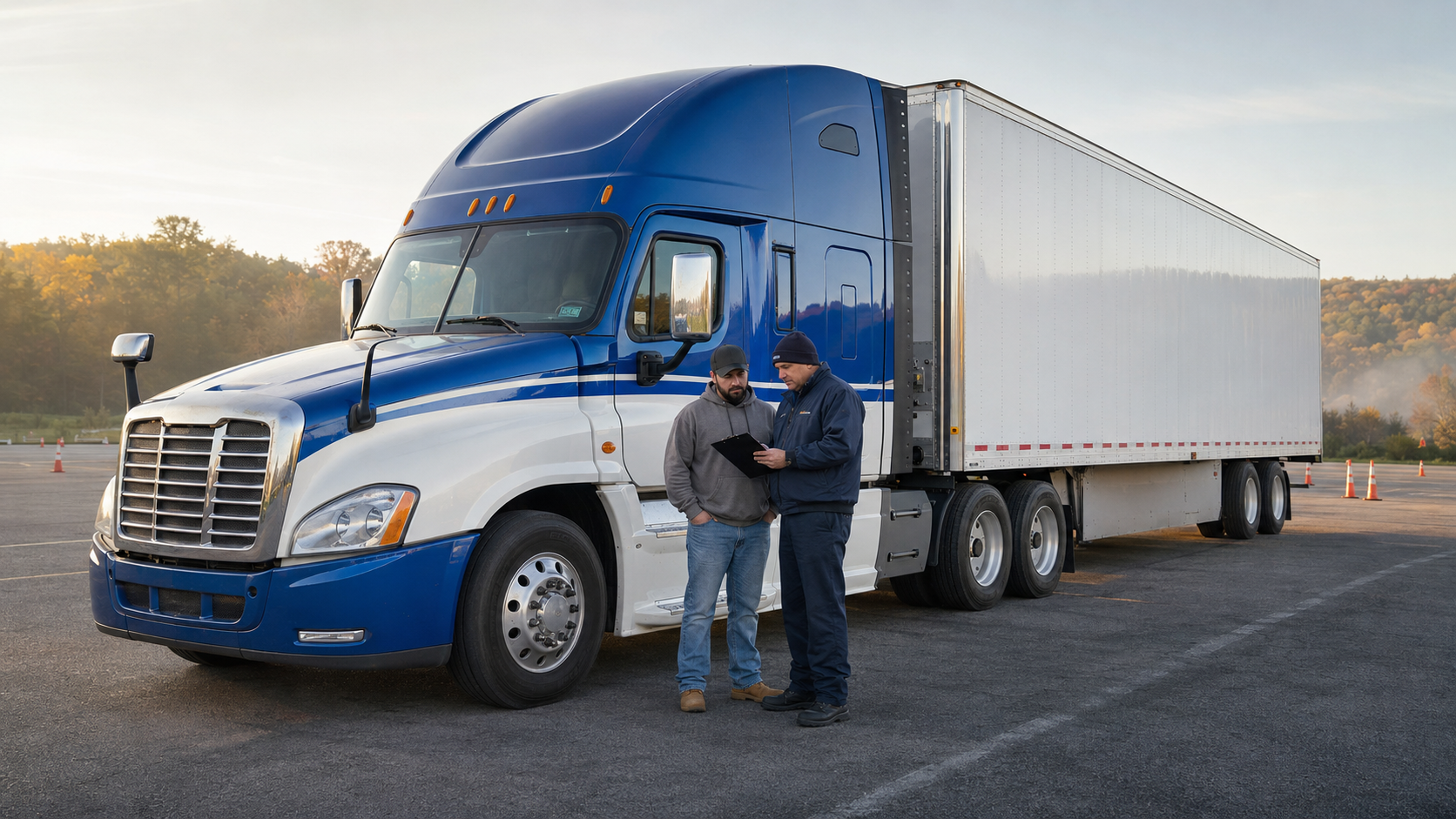
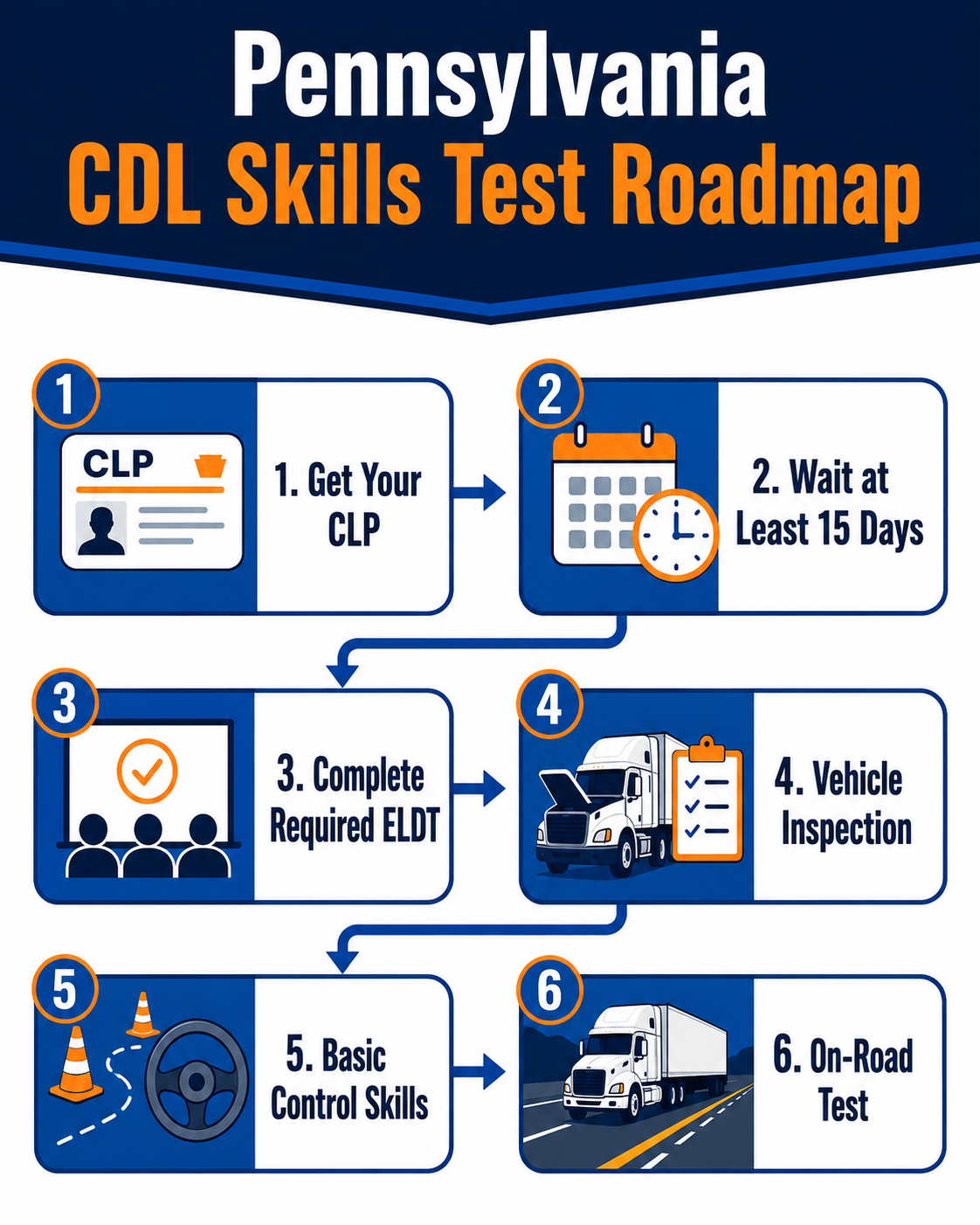
For most first-time Class A and Class B applicants, the path is: obtain the correct CLP, complete required Entry-Level Driver Training with a provider listed in the FMCSA Training Provider Registry, hold the permit for the required waiting period, and pass all three portions of the skills test.
| Stage | What it proves | Best preparation focus |
|---|---|---|
| Vehicle inspection | You can identify safety-critical components and explain what makes them safe | Use one repeatable inspection route and speak clearly |
| Basic control skills | You can position and maneuver the vehicle at low speed | Mirror discipline, setup points, small corrections, and G.O.A.L. |
| On-road driving | You can operate safely in traffic | Space management, signs, turns, lane position, and visible scanning |
If you want structured practice in the same type of commercial vehicle you plan to test in, review the Patriot CDL training programs.
What You Need Before Scheduling the Test
1. The correct commercial learner’s permit
Your CLP must match the class and endorsements needed for the vehicle you will use. Read every restriction printed on the permit. Testing in a vehicle without full air brakes or with an automatic transmission can affect the restrictions placed on the CDL you earn.
2. The required waiting period
For Pennsylvania applicants, PennDOT requires a minimum waiting period of 15 days from the date the CLP is issued until the scheduled CDL skills test. Use that time for coached, repeated practice instead of treating it as calendar downtime.
3. Completed ELDT when it applies
ELDT generally applies to drivers obtaining a Class A or Class B CDL for the first time, upgrading from Class B to Class A, or obtaining a first-time passenger, school bus, or hazardous materials endorsement. The required training must be completed through a provider listed in the FMCSA Training Provider Registry before the relevant skills or knowledge test. FMCSA says providers must submit completion information by midnight of the second business day after training is completed.
4. A compliant test vehicle
The test vehicle must represent the class and type of CDL you want. It should be legally registered, insured, safe, and ready for inspection. Confirm the testing provider’s vehicle-document requirements before the appointment.
| Pre-scheduling check | Ready? | Why it matters |
|---|---|---|
| CLP class and endorsements match the goal | □ | Prevents testing for the wrong license configuration |
| CLP waiting period completed | □ | A test cannot be taken too early |
| ELDT completion is recorded, if required | □ | The state must be able to verify eligibility |
| Vehicle class, transmission, and brake system confirmed | □ | These choices can affect license restrictions |
| Appointment and required documents confirmed | □ | Avoids preventable rescheduling |
The Three Parts of the Pennsylvania CDL Skills Test
Part 1: Vehicle Inspection
The examiner needs evidence that you understand what you are checking—not just that you memorized component names. Build a consistent route around and inside the vehicle. Point to each component, describe its condition, and explain the safety standard in plain language.
- Securely mounted: The component should not be loose or missing hardware.
- Not damaged: Look for cracks, bends, breaks, illegal welds, or excessive wear.
- No leaks: Check air, fuel, coolant, oil, and hydraulic systems where applicable.
- Properly adjusted: Belts, steering components, brakes, mirrors, and other systems need correct condition and adjustment.
- Operational: Lights, warning devices, wipers, horn, gauges, and brake systems must work.
Practice with Patriot CDL’s CDL pre-trip inspection training guide and repeat the same sequence until you can perform it accurately without skipping zones.
Part 2: Basic Control Skills
Low-speed maneuvers reveal whether you understand trailer tracking, reference points, mirror use, and correction timing. Exact exercises depend on the current testing configuration, but preparation commonly includes straight-line backing and one or more offset, alley-dock, or parallel-style maneuvers.
Pass strategy: A slow, controlled maneuver with a planned correction is better than a fast maneuver that creates a dangerous position. Stop, reassess, and use permitted G.O.A.L. checks strategically.
Part 3: On-Road Driving
The road portion tests judgment as much as mechanical control. The examiner observes whether you gather information early, communicate with other road users, and maintain safe space.
- Check mirrors before and after turns, lane changes, braking, and major speed changes.
- Approach intersections at a controllable speed and scan both directions.
- Keep the trailer off curbs and protect the vehicle’s turning space.
- Obey posted signs, lane markings, and railroad-crossing procedures.
- Choose the correct gear before entering a curve or grade.
- Maintain enough following distance for the vehicle, speed, and conditions.
A Realistic Preparation Timeline
A four-week structured program can move a committed beginner from theory to test readiness, but progress should be measured by skill consistency rather than the calendar alone.
| Training phase | Primary objective | Readiness evidence |
|---|---|---|
| Week 1 | ELDT theory, vehicle systems, safety rules, and inspection language | You understand the “why” behind each procedure |
| Week 2 | Pre-trip routine and basic vehicle control | You can repeat a complete sequence with fewer prompts |
| Week 3 | Backing maneuvers and correction strategy | Your setup points and trailer control are consistent |
| Week 4 | Road driving, mock tests, and weak-area correction | You complete full simulations safely under pressure |
Common Reasons CDL Applicants Lose Points
- Memorizing words without understanding components. If the examiner changes the vehicle position or asks a follow-up, the script falls apart.
- Starting a backing maneuver from a poor setup. A rushed setup creates large corrections later.
- Watching only one mirror. The truck and trailer can move into danger on the side you ignore.
- Turning too early or too late. Commercial vehicles need deliberate space management.
- Invisible observation. Move your head and scan clearly enough that the examiner can recognize your checks.
- Letting one error affect the next section. Reset mentally after every maneuver and continue professionally.
Pennsylvania CDL Test-Day Checklist
- □ Valid driver’s license and commercial learner’s permit
- □ Appointment details and testing-location instructions
- □ Required vehicle registration and insurance documents
- □ Correct class and type of commercial vehicle
- □ Vehicle safety check completed before arrival
- □ ELDT completion verified when applicable
- □ Comfortable clothing and footwear suitable for inspection
- □ Early arrival with time to settle and review
Frequently Asked Questions
How long must I hold a Pennsylvania CLP before the skills test?
PennDOT requires a minimum waiting period of 15 days from the date a Pennsylvania CLP is issued until the scheduled Class A, B, or C skills test. Confirm the eligibility date shown for your permit with PennDOT or the testing provider.
Do I need ELDT before taking the Pennsylvania CDL skills test?
Most first-time Class A and Class B applicants, and drivers upgrading from Class B to Class A, must complete applicable ELDT through a provider listed in the FMCSA Training Provider Registry before the skills test.
What happens if I test in an automatic truck?
If you complete the skills test in a vehicle without a manual transmission, an automatic-transmission restriction may be placed on your CDL. Confirm vehicle and restriction rules before testing.
Can a CDL school help me prepare for all three sections?
Yes. A complete program should connect inspection knowledge, controlled range practice, and safe on-road driving. Learn how Patriot CDL structures professional driver preparation.
Educational content only. Verify current requirements, fees, documents, and testing procedures with PennDOT, FMCSA, or your authorized testing provider.